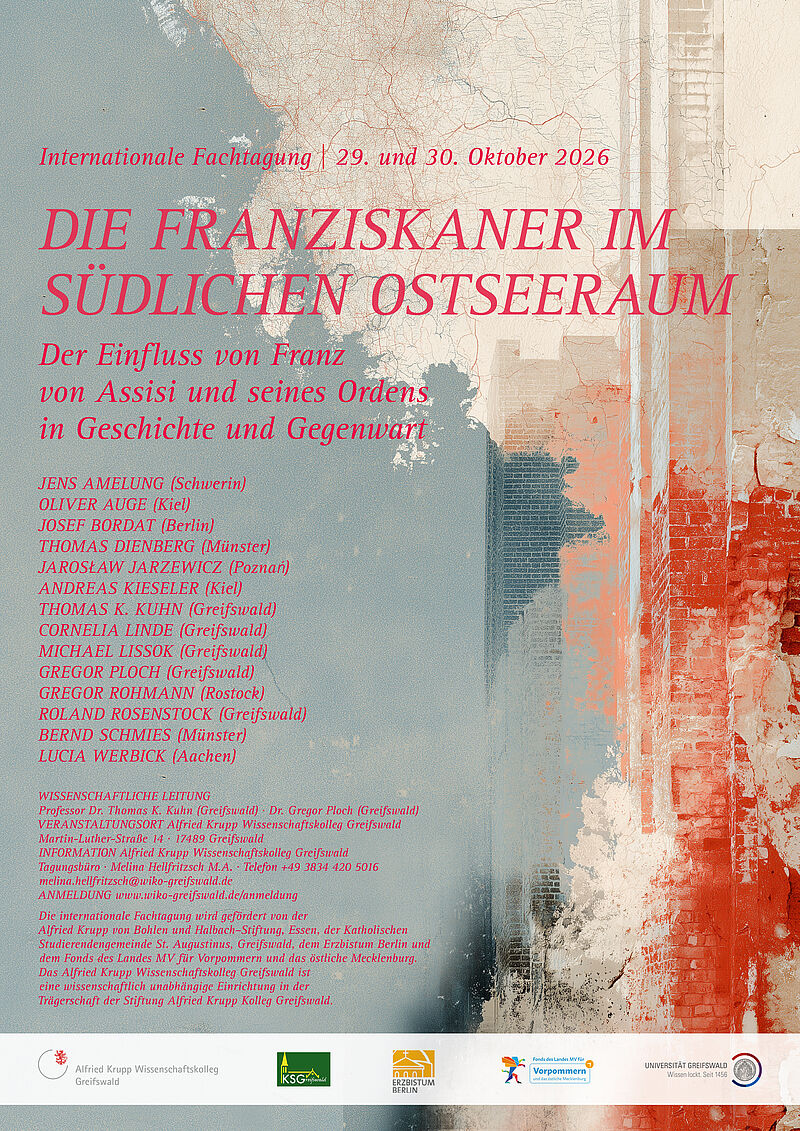
3 October 2026 marks the 800th anniversary of the death of Francis of Assisi. With his radical call for evangelical poverty and his new form of religious life, this canonised founder of a religious order had a lasting impact on the medieval Church and on European religious and cultural history. The Order founded by Francis rapidly developed into one of the most influential spiritual movements of the Middle Ages. Within a few decades, branches had been established in numerous European cities, where the Franciscan communities played a decisive role in shaping pastoral care, preaching, education, piety and urban life.
The conference will examine the influence of the Franciscan Order on the cultural history – in the broadest sense – of the southern Baltic region. The scope of the study is limited to the territories of present-day Germany and Poland. The focus is on the foundation and development of Franciscan monasteries in the Middle Ages, Franciscan iconography, and the subsequent use of former monastery and church buildings after the Reformation within the respective urban-historical context. At the same time, the resulting questions and challenges for heritage conservation and the protection of historic monuments will be discussed. A concluding section is devoted to the reception of Franciscan traditions in the present day. This examines both influences on Protestantism and the ways in which Franciscan ideas have had a lasting impact and been utilised in modern anti-poverty and environmental movements, as well as in the media. Finally, the current work of Franciscan orders and communities will also be examined.
Die Franziskaner im südlichen Ostseeraum. Der Einfluss von Franz von Assisi und seines Ordens in Geschichte und Gegenwart
Event language: German, International conference, Focus: SOCIETY