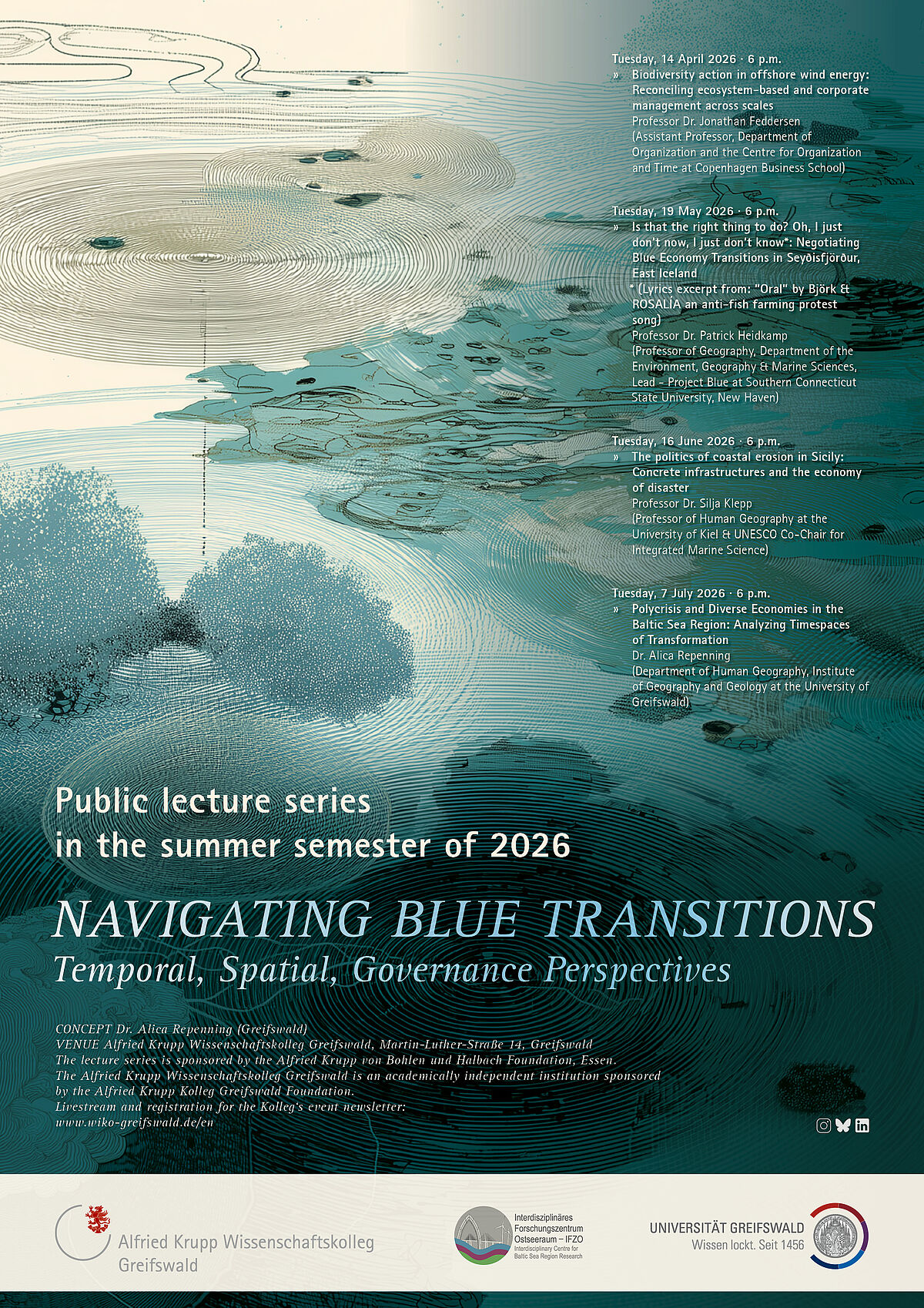
Navigating Blue Transitions: Temporal, Spatial, Governance Perspectives
Concept: Dr. Alica Repenning (Greifswald)
Academic attention to the oceans has intensified in recent years. On the one hand, oceans are increasingly being explored for their innovative potential in addressing climate change. On the other hand, ecological pressures in marine environments are growing, for example with regard to nutrient loads, ocean acidification, and biodiversity loss. In this context, the concept of “blue transitions” has moved to the forefront of scientific and societal debates. These transformations refer to shifts away from traditional forms of use toward more sustainable, environmentally and socially responsible approaches.
The lecture series brings together temporal, spatial, ecological, economic, and societal dimensions to foster a deeper understanding of the dynamics and tensions inherent in blue transitions. It demonstrates that blue transitions entail not only challenges but also opportunities—to develop new governance models through dialogue, to expand room for action, and to translate scientific knowledge into practice.
THEMEN UND TERMINE:
Tuesday, 14 April 2026 · 6 p.m.
» Biodiversity action in offshore wind energy: Reconciling ecosystem-based and corporate management across scales
Professor Dr. Jonathan Feddersen (Assistant Professor, Department of Organization and the Centre for Organization and Time at Copenhagen Business School)
Offshore wind energy is crucial for Europe’s energy transition, yet its large-scale buildout in the Baltic and North Seas poses risks to biodiversity. Based on a qualitative study of Ørsted, a Danish renewable energy company, I examine how Ørsted’s pursuit of biodiversity-net-positive offshore wind farms creates tensions with governmental and ecosystem-level biodiversity targets. I show how the offshore wind farm becomes a ‘focal scale’ for negotiating these tensions. Iterative planning processes and new forms of collaboration among government authorities, developers, and environmental consultants may enable more consistent consideration of biodiversity across scales.
Jonathan Feddersen is an Assistant Professor at the Department of Organization and the Centre for Organization and Time at Copenhagen Business School (Denmark). His research examines how temporal, spatial, and material dimensions shape organizing, with a focus on the collaborative development of sustainable solutions. Empirically, his current research focuses on reconciling offshore wind energy with marine biodiversity. He has published in Organization Studies, Academy of Management Perspectives, and Project Management Journal.
Moderation: Dr. Alica Repenning
Tuesday, 19 May 2026 · 6 p.m.
» Is that the right thing to do? Oh, I just don‘t now, I just don‘t know*: Negotiating Blue Economy Transitions in Seyðisfjörður, East Iceland
* (Lyrics excerpt from: “Oral” by Björk & ROSALÍA an anti-fish farming protest song)
Professor Dr. Patrick Heidkamp (Professor of Geography, Department of the Environment, Geography & Marine Sciences, Lead - Project Blue at Southern Connecticut State University, New Haven)
This lecture explores the contested development of a proposed open-net salmon farm in Seyðisfjörður, East Iceland, as a case study of blue transitions. It highlights how sustainability initiatives in the ocean economy are shaped by multi-scalar conflicts between national ambitions, regional governance, and local community values. Using assemblage theory and critical pragmatism, it explores how stakeholders negotiate resilience and place-based futures. The lecture emphasizes how space, scale, and local imaginaries influence governance, environmental risk, and community identity, demonstrating both the challenges and opportunities of navigating sustainable ocean futures.
Patrick Heidkamp is an environmental economic geographer whose work advances just and sustainable transitions through a theoretical framing grounded in critical pragmatism. He is Professor of Geography at Southern Connecticut State University, holds a recurring teaching appointment at the University Centre of the Westfjords (Iceland), and is affiliated with the High North Center for Business and Governance at Nord University (Norway). His current research explores just transitions in the blue economy, with a strong focus on Arctic and sub-Arctic coastal regions.
Moderation: Dr. Alica Repenning
Tuesday, 16 June 2026 · 6 p.m.
» The politics of coastal erosion in Sicily: Concrete infrastructures and the economy of disaster
Professor Dr. Silja Klepp (Professor of Human Geography at the University of Kiel & UNESCO Co-Chair for Integrated Marine Science)
This lecture explores how coastal governance in Sicily is shaped by political and economic interests that sustain unsustainable protection practices and a form of “coastal disaster capitalism”. Using political ecology and ethnographic research, it shows how dominant narratives of controlling the sea legitimize large-scale infrastructure. The lecture also presents an art-based research approach developed with photographer Barbara Dombrowski, using photography and public dialogue to imagine more just and sustainable coastal futures.
Silja Klepp is Professor of Human Geography at Kiel University and holds the UNESCO Co-Chair for Integrated Marine Science. Her research focuses on human–environment relations in the Anthropocene, with particular emphasis on climate change adaptation, coastal erosion, and disaster governance. Integrating postcolonial perspectives and critical social theory, she explores how social and cultural diversity and community self-determination can be embedded in adaptation strategies. She is co-founder of the transdisciplinary environmental justice network EnJust and actively promotes transdisciplinary and artistic research approaches.
Moderation: Dr. Alica Repenning
Tuesday, 7 July 2026 · 6 p.m.
» Polycrisis and Diverse Economies in the Baltic Sea Region: Analyzing Timespaces of Transformation
Dr. Alica Repenning (Department of Human Geography, Institute of Geography and Geology at the University of Greifswald)
The Baltic Sea region is under pressure to transform toward more sustainable futures on land and sea and toward sovereign and democratic digital spaces. Even though the surrounding countries are digitally advanced and have high sustainability ambitions, the transformation in the region lags behind. This talk takes the Baltic Sea region as an example to analyze the spatial and temporal hindrances of blue transitions in a region. It underlines the transformative frictions of creating different futures in the context of international constellations, a shared blue ecosystem, and in times of multiple equally pressing concerns. It explores how re-introducing diverse economies as a research perspective provides ways forward.
Alica Repenning is a postdoc at the Chair of Human Geography at the University of Greifswald. In her research, she investigates the interplay of entrepreneurship, sustainability, and technology in shaping geographies of change.
Alica Repenning studied Geography at Heidelberg University, Loughborough University, and the University of Copenhagen. From 2019 to 2023, she was a researcher at the Leibniz Institute for Research on Society and Space (IRS). In 2023, she received her doctorate from Humboldt University of Berlin with a thesis focusing on the tensions between online and offline spaces and their temporal contrasts.
Moderation: Dr. Max Roessler